Friday, 18 July 2014

WHAT YOU CAN DO FOR GAZA

Social networking sites are overflowing with enraged posts speaking up for Gaza. Blaming people for inaction, coaxing people into action, almost every fifth post is somehow commenting on the issue, and rightly so- the atrocities have continued for too long and so has the silence. However, realistically speaking, none of these posts are furthering the mission to save Gaza than those who they blame for silence. So what do we do? Frankly, from my Newsfeed, it seems as if nothing “can” be done other than changing my display picture or uploading a status. Thankfully, that is not the truth.

Before we examine the range of ways we have for helping Gaza, we need to first discuss those that are barely helping, if at all. Changing our profile pictures and status updates that support Gaza, serve the same purpose, that of showing solidarity. They speak out against the horrific violation of human rights and demand justice for innocents. Sadly, these posts and/or pictures create a ripple effect so small, that it is almost negligible. Mass cyber protest is definitely a possibility, just a very distant one with very little chances of making any difference at all.

Boycotting products that are US/Israel related is sadly ineffective too, in fact it’s self-damaging. First of all, the proof of any particular company funding the Israeli government is very little and in most cases debatable. Secondly, most of the products that are allegedly funding violence in Gaza, are owned by innocent Pakistanis, here at home. Our boycott which will probably not even deal enough damage to a multi-national company would definitely make a fellow Pakistanis life hard, if not miserable. In other words, we cause ourselves difficulty by boycotting products that can barely be proven guilty of funding Israel, while dealing almost no damage to the real aggressors, if they are aggressors at all.


 “..the least and all we can do to show our solidarity for the people of Gaza is protest on social media…


 Thankfully that’s not true. Countless organizations are collecting money for donations for Gaza through websites, some of these are either collecting money to provide medical or rehabilitative aid to the victims of the Israeli violence like the “UNRWA” which supports around 5 million Palestinians, “Save The Children” which works specifically for the betterment of the Palestinian children, “Muslim Aid” which specializes in helping Muslim victims of disasters or human rights violations, all over the globe and has launched the “Gaza Emergency Appeal” project to specifically help those in Gaza.

 Other organizations are collecting funds to send in terms of social activists that are ready to endanger their lives in order to carry out mass -peaceful- protests in the region. It sounds dangerous and it is, yet these groups are not ready to let that stop them from helping those in need. If they can risk their lives, then the least we can do is support them monetarily if not physically. Such initiatives include the “Free Gaza” organization and “Gaza Ark”.

These are only some of the projects currently underway for the betterment of the Palestinians, and while we all want to do all that we can for those currently being tortured in Gaza, we should not donate blindly, lest a website is fake. That’s why I would personally suggest spending some time researching about the organization you are donating to, especially if it’s online.

Besides these initiatives, all of us can pray for those in Gaza, and moreover we can abstain from spreading hate between the Palestinian and the local Jewish communities of Israel. Palestinians have been subjected to war and suppression for years on end; the crimes against them definitely surmount any justification that the foreign authorities will ever be able to provide, but these people are trying to forge bonds with the local Jewish communities in Israel. Justice for Gaza is imperative but so is peace in that region, anti-semitic posts will eventually destroy any chance there is for peace to be reached in that region. Our anger is justified but we cannot forget who the enemy is, and it is certainly not the local Jewish in Israel, it’s the authorities. Our efforts should be focused to help those in Gaza not only for now, but for the future as well, without peace there is no future for Gaza, and without harmony, there is no peace.


Good thing is, it doesn’t end here. Rather than sharing photos of brutalized children, we can spread the message of all those organizations that are currently helping those in Gaza, not only does it show our solidarity for our brothers and sisters, speaks out against the mayhem created by the Israeli authorities, but it has the potential of changing the lives of millions.

By: Rabab Ahsan

Wednesday, 16 July 2014

10 TEENAGE CLICHÉS

(This list contains ill-disguised humor, and copious amounts of sarcasm. You have been warned.)

1. The teenage boy types www.facebook.com into the browser of his school’s public computer, only to find that one of his other male friends is already logged in. He smiles smugly to himself, and clicks on the ‘update status’ button- ‘I’m gay’ he types in, and laughs maniacally to himself. It’s the greatest hack in the history of the human race, and everyone in the class erupts into laughter. 


2. A fifteen year old guy logs onto a social networking site, scrolling through the front page, checking the pictures other people have posted. Disgusted, he begins to type- ‘GIRLS! Have some respect; cover yourselves when you post something on the internet! This is facebook, not the-rest-of-your-body book!’ Everyone applauds him for his chaste, chivalrous ways. He goes on to become the next male Taylor Swift, teaching young girls that they’re only allowed to be blonde, and rude to other girls for a guy's attention.


 3. Justin Bieber? HAH, more like JUSTINE Beiber! You see, I made a hilarious joke because an eighteen year old boy once upon a time did not fit into the patriarchal definition of masculinity, and should therefore be considered a woman- because women are awful, obviously.


4. ‘Ppl who type lyk dis need to get off the internet and die!’ says the thirteen year old boy, smirking to himself as he thinks of the millions of social networking site users that have not yet learnt to type the way he would like them to. Suddenly, a beam of light shoots out from the sky, and Kurt Vonnegut descends down to Earth, caressing his face in both his hands. ‘Congratulations,’ he says. ‘You’ve done it. Bad grammar is over.’


5. ‘I’m not mean,’ says the girl who insults other people for the sake of mindless entertainment, rips apart everything a girl does because it does not fit into the values she has been brought up on, and judges anyway who decides to not go with the flow. ‘I’m REAL.’


6. ‘Women, you don’t need a man to feel good about yourselves! You are all beautiful, no matter what!’ A boy says, patting himself on the back for his selfless ways. Thank you son, you’ve done it! Sexism is over!


7. ‘But you’re not allowed to like THAT character! He’s evil!’ Well, now I know! I fall into a pit of despair, realizing that my evil, malevolent ways must be diminished, and I too, should only like characters in books and movies that are kind hearted, caring, and most of all acceptable in the eyes of my peers. Remember- no people deserve second chances, not even the fictional ones.


8. ‘LOL, if my boyfriend looked like Chris Brown, I’d let him hit me any day!’ The teenage girl tweets, giggling to herself, imagining Chris Brown’s smarmy smile. All the women in the world who have been raped, beaten, humiliated, or subjected to domestic violence no longer feel pain, because hark; a teenage girl has told them how girls should behave when a man beats the living daylights out of them.


9. The high school kid uploads a picture of himself, and types out a caption: ‘photo credits: [insert name of friend here]. Everyone gasps as they stare at the grainy picture that has been edited on an online photo editing website- what beauty! What art! Surely, this fifteen year old girl who took a picture of her best friend pouting will go on to become the next Annie Lebowitz!


10. YOLO, says the teenage boy. He’s right- we really do only live once, and instead of taking that as a sure sign that wearing your seatbelt when sitting in a car that is driving down the highway is important, the boy proceeds to go to a party where cigarette smoke is blown into unassuming faces and girls are insulted in the mask of compliments.


And with that, I conclude this list. As many profile picture captions have said before- ‘haters gonna hate’.

And indeed, they do seem to continue.


By: Sarah Quraishi

Monday, 14 July 2014

THE MONTH OF TOLERANCE THAT ISN'T

About 1435 years ago, a struggle had already begun; a change of faith that soon swept the Arabian Peninsula, a faith that many say was the epitome of righteousness, fairness and tolerance. Fast forward to present day and you'll find many 'versions' of Islam, each although centered on the belief in a Supreme Being, having its own set of traditions, practices, esteemed leaders and so on.

Some of these versions in their teachings, however, deviate so far from the original (as I would like to refer to it), that, in practice, they fail to maintain a connection with the fundamental concept, while still being associated with it. Jihad is one such example that comes to mind. Unfortunately, Pakistan's legislature is plagued with individuals who embrace such irrational beliefs which inevitably lead to dubious laws such as the Ehtram Ramzan Ordinance of 1981.

The ordinance* prohibits eating and smoking at public places and restaurants are not allowed to serve food after sehri and before iftaar. Theatres and cinemas can only open for three hours a day after iftaar. Cafeterias and restaurants in hospitals, railway stations and bus stands, however, are exempted under the ordinance. Any violations can be punished with a fine and a maximum of three-month prison term.

There are many issues to be highlighted regarding the abovementioned ordinance. Fasting, one of the five pillars of Islam, is the ultimate test of self-control where Muslims must practice patience and tolerance while temporarily being subject to trying conditions of hunger, thirst and restraint, just to name a few. Therefore, the fact that those claiming to propagate Islam are adopting a dogmatic attitude of utter intolerance towards those of other faiths seems essentially hypocritical. Refraining from consuming food publicly should be an act that stems from within an individual out of courtesy, rather than being enforced by legislation. The Holy Qur'an itself states:

“…There is no compulsion in religion…” (2:256).

If not from the Holy Book, why not take an example from the life of the Last Messenger of Allah (P.B.U.H.), the man whose qualities are the benchmark for all Muslims. The same man who prayed for the forgiveness of the people of Ta'if, after they had chased him out of the city by hurling stones and the same man who stood up in reverence when a funeral procession of a Jewish woman passed by. Can no parallels be drawn here?

More disturbing is the fact that in the original text of the ordinance, a public place is made to include “…any hotel, restaurant, canteen, house, room, tent, enclosures, road lane, bridge or other place to which the public have access.” Yes, even a ‘house’ and ‘room’ are included; a clear sign that religious policing does not care to respect the privacy of our homes. No government should have the freedom to exercise such policing as it takes away from the sanctity of the act; as I mentioned earlier, wanting to do something and being forced to do something involve two very contrasting thought processes.

But wait, wasn’t Pakistan made based on Islamic principles with a focus on the Muslim majority? Yes, but Islamic principles neither discriminate against non-Muslims nor do they dictate a need for such a law. Now with this statistical approach to legislation in mind, that so many Pakistanis have come to accept, why was there an uproar then, when the ‘burqa’ was banned in France? The majority of the citizens of France feel uncomfortable by the garb and needless to say, Muslims there are indeed a minority (this is not to say that I agree with the ban; merely citing a reference for comparison). But anyway, that topic warrants its own article.

And let’s not forget that although the law is supposedly only for Muslims and excludes all non-Muslims; however, in 2009 two Christian men were arrested from the city of Silanwali for eating in public. There is little in this news bite that comes as a surprise; with the prevalent poverty and corruption, there is little (if any) anyone can do to prevent some of the law enforcers from making a quick buck or two. Protection of minorities is already almost non-existent and during Ramadan, there is an additional possibility of falling prey to the misuse of the ordinance by those who have suddenly become religiously devout.

Other than an irrational religious basis, the ordinance is also impractical. Consider, for example, those individuals who suffer from chronic illness or injury and women who are in their final stage of pregnancy or are nursing mothers; for them, fasting is not an obligation. Why must they refrain from consumption of food when they are in a condition beyond their control that prevents them from fasting? There may be emergencies where a fasting individual may require food and water with no hospital nearby. Should they be denied dietary requirements which they may possibly need to survive? To put things in perspective, imagine the sale of sugary foods being banned due to the presence of many diabetics in the populace. Clearly, most of us would disagree with the rule.

One might even say that a sound argument may not even be required for the ordinance to exist, simply because religion, just like any lifestyle, boils down to individual choice. Choosing to be Muslim is a matter of choice and with it, comes all the duties and responsibilities that the religion entails. Surely, no one else must be held accountable for it, nor must their freedom be curtailed simply because they do not follow a lifestyle that the majority takes pride in.

Put simply, it is not the abstinence from food and beverages that captures the essence of Ramadan, it is the constant struggle to be good human beings and practice righteousness even in the most challenging of circumstances. Here's hoping to a month filled with the true essence of Islam instead of mindless religious fervor. Ramadan Mubarak!


*The original print of the ordinance can be found at http://goo.gl/vW3YnW.

By: Ashhad Qureshi

Friday, 11 July 2014

The Iftari Diaries: Sumy’s


Sumy’s is a refreshingly new, yet surprisingly old little burger joint a few steps away from my house. I never knew it existed- maybe it was the logo which shockingly resembles the Bake Parlor symbol, or the fact that it always looked closed. It’s one of those places whose existence never seems to make any difference to our lives. That is, until we actually try it. After the recommendation of a friend, I decided to try it out. The experience was a rather unusual one. The fact that it was emptier than a cricket stadium during a FIFA world cup final match wasn’t very encouraging and the air conditioning-less, fan-less atmosphere only seemed to add to that. Don’t make up your mind just yet, this is where it gets interesting. 


Empty or not, the names of the burgers complemented by the tempting pictures and ridiculously low prices would make anyone, budget or not, salivate. The choice between the ‘Cheese Wiz’ and ‘the Big Kahuna’ was a tough one but I decided to go with the latter. No secrets here, it cost me PKR.380 which is astonishingly cheap if compared to other burgers on the market that house two quarter pounder, char grilled patties.  Apparently, if the posters there are to be believed, it’s been voted “best burger in town by some guy who likes burgers”. That one made me chuckle. Finally the behemoth of a burger arrived at my table with a handful of golden French fries neighboring it. The fries were too soft for my taste but good nonetheless. I’m not a huge fan of their fries, considering that a piece of fried chicken there would cost you just as much. Now to the Kahuna itself. Two lusciously good looking patties separated by a slice of cheese oozing some red sauce which I didn’t bother asking about; and no, it wasn’t ketchup. It was one of those rare moments when a burger actually resembles itself on a poster, like a model who looks the same without make up. Right from the first bite I could tell that Sumy’s means business when it comes to their burgers.

As filling as it was tasty, I would definitely recommend this place to anyone who likes burgers regardless of the price which is just an added benefit. If I had to grade it out of ten I would give the fries a six and the burger an eight. This should be encouraging as McDonalds’ “big tasty” only managed to score a seven. If two don’t seem enough, add a third or a fourth patty if you’re feeling particularly daring just for an added hundred rupees per patty. Sumy’s has firmly put itself in the hot seat for a good candidate to be my afternoon snack. I would seriously think twice before going to McDonalds or KFC with Sumy’s lurking in the shadows.

By: Mujtaba Khalid 

Wednesday, 9 July 2014

FIFA Through The Ages


Every four years fans around the world join together to watch the FIFA World Cup, the most viewed and followed sporting event on Earth, with more fans than even the Olympics. This year's Cup in Brazil is no exception; nearly 3 million tickets have been sold, and the knockout stages haven't even begun! Football is by far the most widespread sport on the planet, but this hasn't always been the case.

In fact, it wasn't until the beginning of the 20th century the football began to be played between countries – the first official match between two national teams outside of Britain took place in 1902, between Uruguay and Argentina. Football was played in the Olympics from 1900 onwards, but at first between clubs instead of national teams, and more importantly, only by amateur players. FIFA, which was formed in 1904, tried to organize a tournament outside of the Olympics in 1906, but it was a failure – even according to FIFA's own official history.

Eventually, FIFA agreed to recognize Olympic football as the world football championship for amateurs, and took responsibility for the event. However, the 1932 Olympics, which were to be held in Los Angeles, were not to have football because of it's low popularity in the United States. This, along with disagreements with the International Olympic Committee over the amateur player policy lead to FIFA deciding in 1928 that they would organize their own tournament. This was the beginning of the World Cup as we know it today.

The inaugural World Cup was held in 1930 in Uruguay, with selected national teams invited by FIFA. However, the decision to host the Cup in South America meant that the European teams would all have to endure the trip across the Atlantic. The FIFA president himself had to persuade teams himself to play, and in the end only four European teams did. Thus, the first World Cup was played between just 13 teams. 

Ironically enough, one of these teams was from the USA, whose Bert Patenaude also scored the first World Cup hat trick. Eight years later, Poland's Ernest Willimowski became the first player to score four goals in a single World Cup game, which wouldn't be beaten until 1994. The next two World Cups, meant to be held in 1942 and 1946 were canceled because of World War II.

The World Cup resumed again in 1950, and the final saw the highest attendance of any match ever: 199,000. The next one saw the highest average goals per game, the highest scoring team and the most goals in a single World Cup match. Frenchman Just Fontaine would then score the most goals in any World Cup in 1958. 1962 would see Colombia's Marcos Coll score a goal directly from a corner kick, the only time that feat, known as an “Olympic goal” has been achieved in a World Cup.

England hosted the first World Cup to have significant marketing in 1966, where there was an official mascot and logo for the first time. The trophy was stolen before the tournament, but found a week a later by a dog named “Pickles”. The English Geoff Hurst scored the only ever hat-trick in a World Cup final that year. The next Cup would see what has been called the best save ever by the English goalkeeper Gordan Banks. 1974 brought in a new trophy, and was the first time the Total Football tactic, in which every field player can play in every position, was used in the World Cup.

The 1982 World Cup saw an expansion to 24 teams. During the group stages, Hungary beat El Salvador 10-1, the only time a team has gotten 10 goals in a World Cup match. There was incident between Kuwait and France when the Kuwaiti team stopped playing because they heard a whistle which turned out to be from a fan in the stands. The French defender Maxime Bossis scored, but the referee disallowed the goal after hearing an earful from the president of Kuwait's Football Association. Bossis scored again a few minutes later. Kuwait ended up losing 4-1.

The 1990 World Cup witnessed a strange record from the Irish team, who reached the quarterfinals without winning a single match. They drew all three matches in their group stage and made it past the Round of 16 by winning a penalty shootout after drawing yet again. The following World Cup saw tragedy when Colombian Andres Escobar was murdered ten days after he hit an own goal that knocked Colombia out. However, it also had the highest total attendance of any World Cup, and the most goals by a single player in a match by the Russian Oleg Salenko.

The World Cup was expanded again in 1998 to 32 teams. Iran beat the Maldives in a qualification match 17-0, setting a new record.  Australia beat that record in 2002 in 31-0 win against American Samoa – which translates to a goal every three minutes or so. In 2006, four African teams debuted, with Ghana beating the Czech Republic, who were ranked third, and then making it to the quarter finals. The 2010 World Cup final saw a record number of yellow cards, with the Dutch playing nearly violently. They eventually lost thanks to header in the last five minutes of extra time by the Spaniard Iniesta.


That brings us, of course, to the present day, with the 2014 Cup being held in Brazil, which has already shockingly seen Spain getting knocked out and upsets from Costa Rica. World Cup favourites, Brazil, were taken apart by the German side with a shocking result of 7-1, as Germany inch “Klose-r” to the title. Looks like we’ve got a World Cup just as exciting as its predecessors, and perhaps even a few more records getting broken to boot!

By: Humza Hemani

Sunday, 29 June 2014

FIFA SERIES: THE SITUATION IN BRAZIL

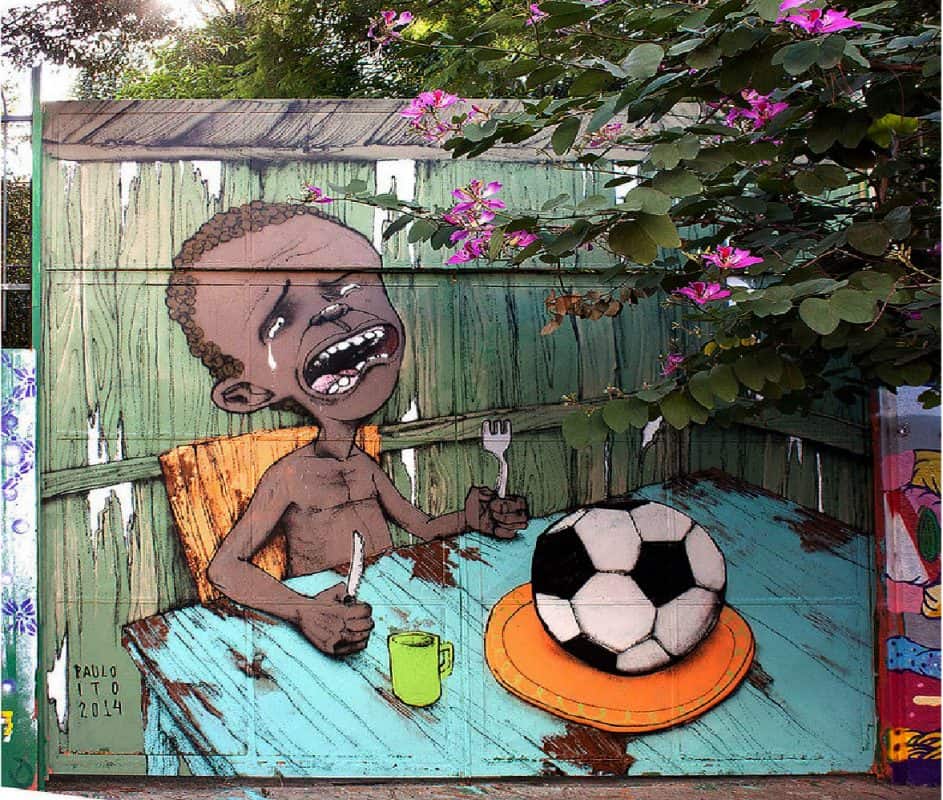
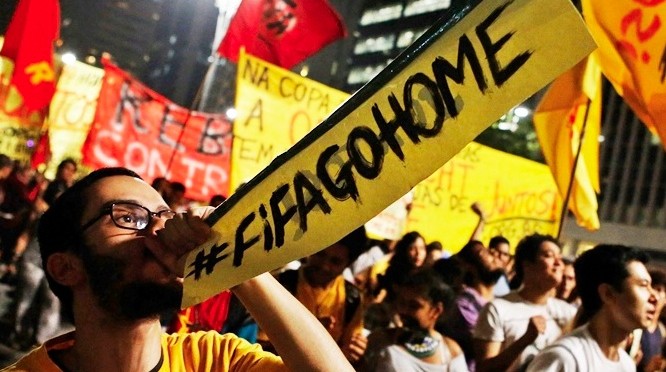
With the much awaited FIFA World Cup in full swing, most international viewers are absorbed in the on-field action- completely oblivious to the big picture. The World Cup has adversely affected both the Brazilian citizens and the government. The investments poured in by the government to orchestrate this year’s “much-awaited event” have caused mass protests in Brazil, that have not only resulted in  the loss of lives, but forced the government into highly expensive peace-keeping measures, further endangering the economy. 

The World Cup is expected to generate a profit of above $3 billion that was considered to be able to greatly stabilize the Brazilian economy and maybe even give it a large boost; however, what escapes this optimistic assessment is that the Brazilian government has already spent over US$11.5 billion into the tournament.  The protests are not entirely a surprising affair- the general discontent had sprouted in another tournament last summer, when people rioted and protested against problems ranging from the over-expenditure of the government, corruption, tax breaks given to FIFA, to increased bus fares. It is important at this moment, to consider that there have been serious social indirect costs of the World Cup as well-  an average of one construction worker a month has died while working on the various construction related projects of the tournament,  much like the issues that have arisen in Qatar.

Due to increased criminal activity in the hosting country, Brazilian authorities had launched “Operation Pacification”. With both criminal activity and civil disobedience at rise, the government is currently spending $855 million on strengthening national security. This coupled with the lavish expenditure on FIFA World Cup has crippled the Brazilian financial system. Implications are explicit while the Brazilian economy continues to plunge, and the average Brazilian is left with more than a bitter taste of the world’s football celebrations.  The protests have sadly culminated into many violent clashes between the authorities and the protesters, costing more than 10 deaths and over 200 serious injuries with more than 400 arrests.


While the origins of these riots are certainly pre-World Cup, the effects are certainly far-reaching and damaging.  The celebration of one of the most celebrated sport and its biggest event, are marred by bloodshed, discontent and an air of mass disobedience. Within our modern society and its extensive, comprehensive social charters, we should certainly realize that no medium of entertainment, however celebrated, should impact the general populace so adversely. It is not unknown for hosting countries to encounter financial issues while hosting tournaments as large as the FIFA World Cup, but for such events to cause such mercurial change in the general atmosphere and impair peace is certainly too great a cost for a tournament which could just as easily be held in a more stable country.  One can only hope that football fans and organizers alike would rally against such arrangements in the future, and a more humanitarian vision will be adopted in organizing such mega events for football or otherwise. 
                                        

By: Rabab Ahsan

Tuesday, 24 June 2014

Of Exceptional Females, and Harry Potter Characters


The only thing that makes me angrier than a female protagonist that is helpless, defenseless and a waste of paper is a female protagonist that is portrayed as the strongest, smartest, and most desirable woman in the entire book.

Hello, I like contradictions. But I don’t like Ginny Weasley.

Ginny Weasley is what we would refer to as the ‘exceptional women’. “Exceptional Woman” refers to a woman, who is the best and awesome-est at what she does, but she’s still only playing the game that is reserved for boys, an example, Princess Lea, who is also the only female character in the entire trilogy. Women get to be either the best, or non-existent, because apparently only men get to be average.

Let’s be serious- great female protagonists, even good ones, are hard to find in novels. Authors really don’t seem to know how to play it; to write a character that can’t seem to do anything herself, or a woman who is so independent, she can’t even stand the thought of two boys being in love with her throughout the entire series? It’s been seen throughout the history of young adult fiction.

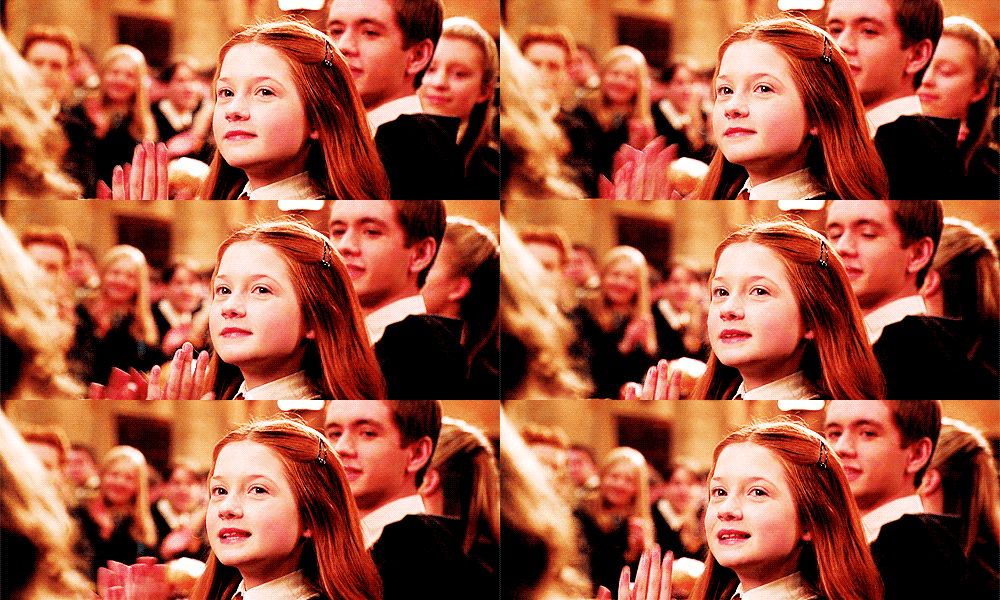
Ginny Weasley really did show up out of the blue- we did, of course, see her in the first four books, where she was shy, quiet, undeniably infatuated with Harry Potter…and possessed by a diary in the girls’ bathroom. But suddenly when the rest of the books came out, Ginny Weasley became super woman 2.0. The best at hexes, the snarkiest when it came to insults, and obviously much prettier than all the other girls, not even the Boy Who Lived could stay away from her. She was never ashamed of her countless boyfriends, or her poverty, or any clichés that should be worried about when it comes to being a teenage girl. All in all, J.K Rowling took every possible quality a human could want, and bestowed it on Ron Weasley’s little sister.  


I really tried to like Ginny the way I liked every other character in the book- she had qualities that made people like her, I’m sure of it, but she just seemed a little too great for my taste. Out of the hundreds of students that attended Hogwarts, she was the only person who stuck up for Luna? The only person who made it into the Slug Club without connections? She alone won the award of BEST chaser, even after Katie Bell had been on the team for six long years?

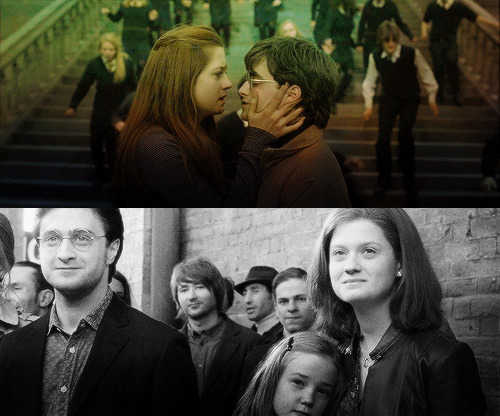
What bothered me the most was that all of these qualities that were bestowed upon her were not an attempt to make a funny, strong female lead- they were given to her so that she would be good enough for Harry. Harry only seems to like her after she’s wooed plenty of men with her feminine wiles; only after she makes sure not to cry like all the other girls, or when she’s treated like a special snowflake for being oh so strong, and oh so witty. Ginny Weasley, it seems, was planned out from the beginning to date Harry as a reward, as if he needed something to make up for the horrible years spent in battling Voldemort and wizarding angst.
Ginny Weasley has had her moments, every character in the series has, but after the books are finished, and the story has been closed, I’ll always remember Ginny as the girl who reminded me of the one person in your class that is the best at everything, and you alone can see all of their flaws.

By: Sarah Quraishi